Agricultural Consultant
Agricultural consultants advise farmers and agribusinesses on how to run their operations more productively and sustainably, using farm data, research and business analysis.
- Median salary*
- $88,400
4.2%vs last year, before tax
- People employed
- 2,000
0.0%vs last year
- Projected growth
- +17.5%
to 2035
- AI exposure*
- Moderate
- automation risk
- Average hours
- 44/wk
+4h vs all jobs
- Shortage status
- In shortage
national
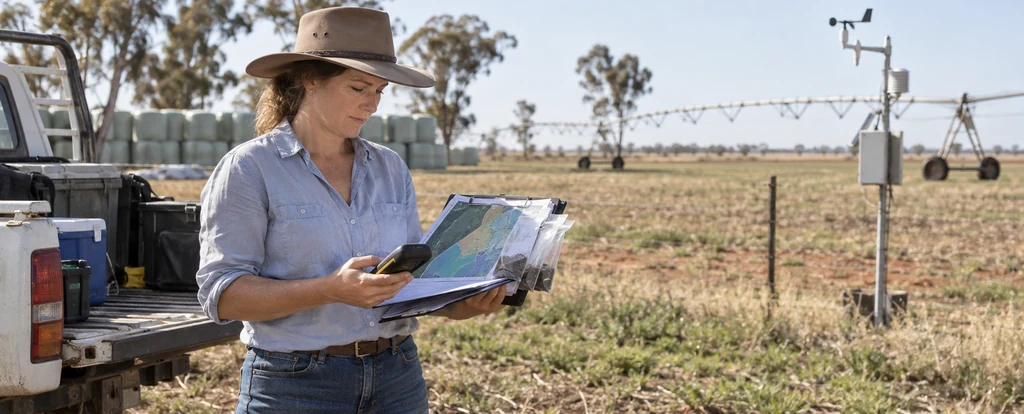
Most agricultural consultants work for private advisory firms, agribusiness companies, grower groups or government agencies, and some run their own practice. The job sits between the paddock and the balance sheet: where an agronomist concentrates on crop and soil advice for a season, a consultant looks at the whole farm business, from pasture and livestock through to budgets and succession. Days are split between travelling to client properties and doing the analysis, reporting and meetings back at a desk.
How much do agricultural consultants earn?
The median full-time salary for an agricultural consultant is $88,400 per annum, before tax, up $18,600 since 2018.
Pay depends heavily on who you work for: government agencies and grower groups pay to set classifications and enterprise agreements, while private advisory firms tie earnings to your client load and the work you bring in or lead. Specialist skills such as soil carbon, agtech adoption or succession planning tend to be worth more than general advisory work. Consultants who run their own practice set their own fees and carry the travel, software and insurance costs themselves.
What does an agricultural consultant do day to day?
The list below is what fills most weeks; the exact mix shifts with seniority and whatever stage the current work is at.
- Visiting farms to inspect paddocks, livestock and irrigation, and talking through the season with the owner.
- Building budgets, cash flow forecasts and whole-farm business plans alongside the client.
- Running soil, pasture and production records through farm management software and mapping tools such as AgriWebb and QGIS.
- Interpreting trial results and research findings, then working out what applies to the client's soil, climate and budget.
- Writing reports and presenting findings at field days, grower group meetings or farm board sessions.
What skills do agricultural consultants need?
Employers look for data analysis, economic modelling, strategy development, backed by AgriWebb fluency and strong client relationships and advisory.
Specialist skills
- Data analysis
- Economic modelling
- Strategy development
- Environmental assessment
Software and tools
- AgriWebb
- Xero
- Microsoft Excel
- FarmMap4D
- QGIS
General skills
- Client relationships and advisory
- Written communication
- Problem solving
- Stakeholder management
Is the job growing?
About 2,000 people work as agricultural consultants in Australia, and employment is projected to grow 17.5% over the decade to 2035. That's healthy, above-average growth, and the role should stay in solid demand.
How do you become an agricultural consultant?
Here's the path most agricultural consultants take, step by step.
- 1Finish Year 12 with maths and a science
Biology, chemistry and agricultural science subjects make the first year of a degree easier. There is no single prerequisite, but most agricultural science degrees assume you are comfortable with maths.
- 2Complete a bachelor degree
A three or four year degree in agricultural science, agribusiness, environmental science or a related field is the usual entry point. Around 39% of the people working as agricultural consultants hold a bachelor degree.
- 3Get field time before you graduate
Seasonal harvest work, livestock handling or an internship with an agribusiness or advisory firm is paid work that puts you on properties and in front of growers, and it counts when you apply for a graduate advisory role.
- 4Build a speciality
Around 22% of agricultural consultants hold a postgraduate qualification, often a masters in agricultural science, agribusiness or a related area. Specialising in soils, livestock systems, carbon or farm business gives you something specific to offer clients.
- 5Join the professional body
The Ag Institute Australia is the main professional body for agricultural scientists and advisers, and membership brings continuing professional development and a network of people who pass work on.
Ready to apply as an agricultural consultant?
Whether you're working toward becoming an agricultural consultant or already are one and want a hand with the next step (sharpening your resume for ATS screening, tightening your cover letter, or knowing what you'll actually be asked at interview), here are examples grounded in this specific role, not generic templates.
What jobs can an agricultural consultant move to?
Moving into Agronomist typically comes with the biggest pay rise, worth $19,400 a year more on average.
| Move to | Typical pay change | Overlap | Retraining |
|---|---|---|---|
| Agronomist An agricultural consultant's farm systems knowledge transfers directly into agronomy, with further study in crop science and pest management.Known move | +$19,400 | 41% | reskill |
| Soil Scientist Agricultural consultants can specialise in soil science, applying their farm systems knowledge to soil health and land management. | +$7,800 | 31% | reskill |
Moves are chosen from Jobs and Skills Australia's Data on Occupation Mobility, which follows income tax records between 2011-12 and 2020-21, together with entry requirements and skill overlap. A known move is one people were seen making in that data. Pay change compares median full-time pay for the two roles.
Who works as an agricultural consultant?
The typical agricultural consultant is 50 years old; 68% are men, 71% work full-time, and full-timers average 44 hours a week.
- 50
- Median age
- 32%
- Female share
- 71%
- Full-time
- +4h
- vs all-jobs avg
What's it like being an agricultural consultant?
The job follows the farming calendar, so there are quiet weeks of analysis and reporting and then frantic ones when a client needs a decision before sowing or shearing. Full-time consultants average 44 hours a week, and a good part of that is spent on the road between properties. It suits people who like solving practical problems with numbers and are happy to sit at a kitchen table and explain a recommendation to the person who has to act on it.
What people like
- You see whether your advice worked. A recommendation about pasture, stock rates or a farm budget plays out within a season or two, so you get feedback rather than a report that disappears into a drawer.
- The week moves between office and paddock. Property visits break up the analysis and writing, which suits people who would rather not spend five days a week at a desk.
- Client relationships run for years. Many consultants stay with the same families and businesses across seasons, which means you know the country, the stock and the history behind each decision.
- Specialising is open to you. You can build a name in soil health, carbon accounting, agtech adoption or succession planning, and that speciality shapes the clients who seek you out.
What people find hard
- Travel takes up the week. Properties can be hours apart, and a single farm visit can mean a long day of driving before any of the analysis starts.
- The season does not wait. When a grower needs an answer before sowing or a bank needs a cash flow before a deadline, the work arrives at a fixed time whether or not your week has room.
- Some recommendations are unwelcome. Part of the job is telling a client that a plan will not stack up, or that a change is needed on a property the family has run the same way for decades.
- Income can depend on the client base. In private practice, quiet periods and lost clients show up in your earnings, and unpaid preparation often goes into winning the next piece of work.
Based on our synthesis of professional-body surveys and public accounts of the role, not first-person verified reviews.
Which industries employ agricultural consultants?
Agriculture, Forestry and Fishing employs the largest share of agricultural consultants, followed by Public Administration and Safety.
Top employing industries
- 1Agriculture, Forestry and Fishing
- 2Public Administration and Safety
- 3Professional, Scientific and Technical Services
Ranked by employment share; the source doesn't publish an exact percentage per industry.
| Bachelor degree | 38.9% | |
|---|---|---|
| Postgraduate | 22.2% | |
| Diploma / Advanced Diploma | 13.7% | |
| Year 12 or below | 13.7% | |
| Certificate III/IV | 8.4% |
Will AI replace agricultural consultants?
Agricultural consulting sits in the middle: a lot of the analysis, record-keeping and reporting is already automated, but the job rests on judgement and relationships that software does not replace. Farm platforms, satellite imagery and AI drafting tools take hours out of the desk work, which shifts the value of a consultant towards interpreting the numbers and being trusted with a farm's decisions.
Share of typical working time by exposure level
- On-farm inspection and client conversationsReading a paddock, a mob of cattle or a grower's hesitation about a big spend happens on the property, and it is usually what decides whether the recommendation gets adopted.35%low
- Farm data analysis and benchmarkingPlatforms such as AgriWebb and satellite pasture tools assemble production and rainfall records automatically, so the consultant spends less time collating and more time working out what the gap between two farms actually means.25%moderate
- Budgets and cash flow modellingSpreadsheets and AI-assisted models draft a cash flow or a scenario in minutes, but someone still has to choose the stocking rate, price and interest assumptions that suit that client's operation.20%high
- Reports, grant applications and recommendationsDraft reports, compliance summaries and grant paperwork can be generated from the data, while the consultant signs off on the recommendation and the reasoning that sits behind it.20%high
Common questions about becoming an agricultural consultant
Straight answers to the questions people ask most.
How much do agricultural consultants earn?
Agricultural consultants earn a median of $88,400 per year before tax, and that figure spans everyone from new graduates to principals of established practices. Experience, speciality and employer type move it more than anything else, so a government classification role and a fee-based private practice can pay quite differently at the same career stage.
How do you become an agricultural consultant?
The usual route is a bachelor degree in agricultural science, agribusiness or a related field, followed by field experience and a graduate advisory role. Around 22% of people in the job also hold a postgraduate qualification, which is common for those who move into the work from another science or business background.
Are agricultural consultants in demand?
Agricultural consultants are currently in shortage nationally, and employment is projected to grow 17.5% over the decade to 2035. Keep in mind that the occupation is small, with about 2,000 people working in it, so vacancies appear steadily rather than in large rounds, and regional centres near intensive farming tend to advertise most of them.
Will AI replace agricultural consultants?
Not the advisory relationship, but it changes the analysis. Farm platforms, satellite imagery and AI drafting tools now handle much of the record-keeping, pasture measurement and report writing that used to take days. What stays with the consultant is judging whether a recommendation actually fits the paddock, the season and the client's finances, and being trusted to say so.
Where can agricultural consultants move next?
Agricultural consultants and agronomists share a working knowledge of farm systems, and the move into crop and soil advice usually needs further study in crop science and pest management. Soil science is a shorter jump and pays about $7,800 more. Many consultants eventually run their own advisory practice, which is often where earnings grow.
Do agricultural consultants have to live in the country?
Many do, because the work is built around property visits and regional employers tend to hire locally. Others are based in a capital city and travel for blocks of days, or work on policy, research and agtech from an office.
Related roles
Not sure this is you? Take the career quiz and get a ranked shortlist of roles that fit how you like to work.