Home Manufacturing & Production
Glass Production Operator
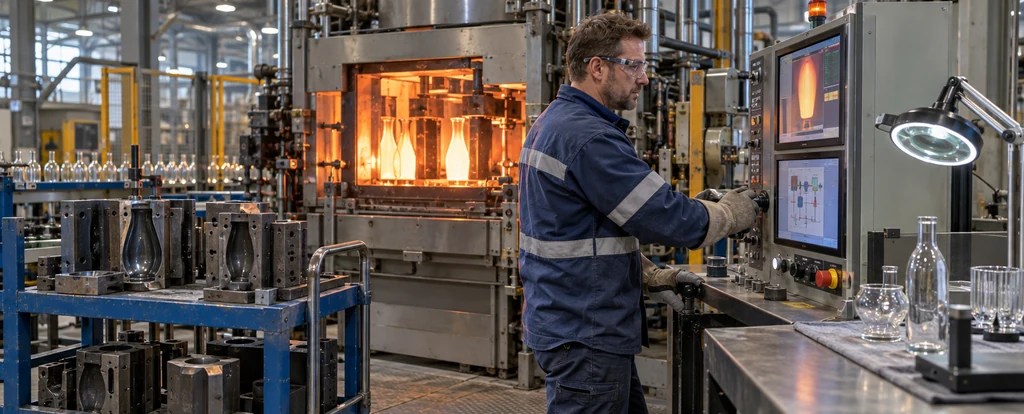
Glass production operators run the furnaces, forming machines and finishing lines that turn molten glass into bottles, jars, windows and specialist products, and their control of temperature and timing keeps output consistent.
- Median salary*
- $65,000
4.2%vs last year, before tax
- People employed
- 1,200
0.0%vs last year
- Projected growth*
- −4%
to 2035
- AI exposure*
- Moderate
- automation risk
- Average hours*
- 38/wk
−2h vs all jobs
- Shortage status*
- Not in shortage
national
Glass production operators work in plants where furnaces run continuously, turning sand, soda ash and recycled glass into containers, flat glass and specialist products. The work sits close to the furnace and the forming line, which is what separates it from general process work in other factories. Most sites run around the clock, so shifts and handovers shape the week.
How much do glass production operators earn?
The median full-time salary for a glass production operator is $65,000 per annum, before tax, up $13,600 since 2018.
Because the furnaces run continuously, shift loadings, night rates and overtime make up a real part of take-home pay, and rates are usually set by an enterprise agreement at the larger manufacturers. Pay also rises with the responsibility you carry, from packing and inspection through to furnace and forming machine control, and it varies with the product area you work in.
What does a glass production operator do day to day?
The list below is what fills most weeks; the exact mix shifts with seniority and whatever stage the current work is at.
- Monitoring furnace temperatures, molten glass flow and the forehearth
- Operating and adjusting forming, moulding and pressing machines
- Inspecting finished glass for bubbles, cracks and dimensional faults
- Changing moulds and settings between product runs
- Recording production data and carrying out routine cleaning and maintenance
What skills do glass production operators need?
Employers look for operations management, plant and equipment operation, worksite safety management, backed by SCADA systems fluency and strong safety and compliance awareness.
Specialist skills
- Operations management
- Plant and equipment operation
- Worksite safety management
- Process improvement
Software and tools
- SCADA systems
- Furnace control systems
- IS forming machines
- Optical inspection systems
- CMMS maintenance software
General skills
- Safety and compliance awareness
- Attention to detail
- Physical stamina and dexterity
Is the job growing?
About 1,200 people work as glass production operators in Australia, and employment is projected to decline 4% over the decade to 2035. That's a real decline, worth weighing carefully before training into the role.
How do you become a glass production operator?
Here's the path most glass production operators take, step by step.
- 1Get a start on a plant line
Most operators enter as a production worker, trainee or labourer, learning the furnace and forming line on the job while earning a wage. Prior glass experience is not expected.
- 2Complete a Certificate III
A Certificate III in Glass and Glazing (MSF30422) or a Certificate III in Process Manufacturing (MSM30116) covers glass handling, quality and safe plant operation, and can be done as a traineeship while you work.
- 3Add the licences the site needs
A forklift licence is common on glass sites, and a White Card is required if you handle or install flat glass on construction projects. Both are short courses.
- 4Build furnace and changeover experience
Moving from packing and inspection into furnace or forming machine control is what lifts pay and opens team leader, quality and technical roles. A diploma in process manufacturing or engineering is one route into those.
Ready to apply as a glass production operator?
Whether you're working toward becoming a glass production operator or already are one and want a hand with the next step (sharpening your resume for ATS screening, tightening your cover letter, or knowing what you'll actually be asked at interview), here are examples grounded in this specific role, not generic templates.
What jobs can a glass production operator move to?
Moving into Chemical Plant Operator typically comes with the biggest pay rise, worth $41,600 a year more on average.
| Move to | Typical pay change | Overlap | Retraining |
|---|---|---|---|
| Chemical Plant Operator Glass production operators bring temperature and flow control experience to chemical plant operation, requiring a short course. | +$41,600 | 65% | short course |
| Power Station Operator Glass production operators bring continuous process control and safety monitoring to power station operation, requiring a short course. | +$39,000 | 68% | short course |
| Boiler Operator Glass production operators bring furnace control and process monitoring skills to boiler operation, needing a short course. | +$27,600 | 74% | short course |
| Concrete Batching Plant Operator Glass production operators bring batching and plant machinery skills to concrete batching, with minimal retraining needed. | +$10,400 | 74% | minimal |
| Rubber Machine Operator Glass production operators bring machine monitoring and quality control skills to rubber machine operation, with minimal retraining. | +$5,200 | 76% | minimal |
Moves are chosen from Jobs and Skills Australia's Data on Occupation Mobility, which follows income tax records between 2011-12 and 2020-21, together with entry requirements and skill overlap. A known move is one people were seen making in that data. Pay change compares median full-time pay for the two roles.
Who works as a glass production operator?
The typical glass production operator is 44 years old; 95% are men, 88% work full-time, and full-timers average 38 hours a week.
- 44
- Median age
- 5%
- Female share
- 88%
- Full-time
- −2h
- vs all-jobs avg
What's it like being a glass production operator?
The job follows the furnace, which runs for years without shutting down, so your week is built around shifts, handovers and keeping a continuous process steady. It suits people who like working with machinery, notice small changes and are comfortable with heat, noise and a fixed routine. The pressure comes in short bursts when a line stops or a product changeover goes wrong.
What people like
- A process that never stops. Glass furnaces run continuously, so the plant has a steady rhythm and every shift starts and ends with a clear handover to the next crew.
- Output you can hold. Bottles, jars and panes come off the line in front of you, and a good run is easy to see in the finished pallets.
- Skills that carry to other plants. Furnace control, flow monitoring and safe plant operation transfer to boiler rooms, power stations and other continuous-process sites.
- Small teams with clear roles. On a forming line or a packing line you know who is doing what, which keeps the shifts predictable.
What people find hard
- Heat and noise on the floor. Working near a furnace and forming machines means PPE, warm conditions and constant machine noise through the shift.
- Nights, weekends and rotating rosters. Continuous furnaces mean someone is always on, so night shifts and public holidays are part of the job rather than an exception.
- A stopped line is expensive. When a machine jams or ware goes out of specification, the pressure to get it running again arrives quickly.
- Few employers, often one location. Most jobs sit in large plants, so your options can depend on what is within commuting distance or whether you are willing to move.
Based on our synthesis of professional-body surveys and public accounts of the role, not first-person verified reviews.
Which industries employ glass production operators?
Glass and glass product manufacturing employs the largest share of glass production operators, followed by Building construction.
Top employing industries
- 1Glass and glass product manufacturing
- 2Building construction
- 3Beverage and container manufacturing
- 4Automotive and transport equipment manufacturing
- 5Furniture and other manufacturing
Ranked by employment share; the source doesn't publish an exact percentage per industry.
| Certificate III/IV | 34% | |
|---|---|---|
| Diploma / Advanced Diploma | 26% | |
| Bachelor degree | 20% | |
| Year 12 or below | 20% |
Will AI replace glass production operators?
Glass production operation has moderate exposure to AI and automation. Furnace control, forming and inspection are all heavily instrumented, so much of the routine watching is already handled by SCADA, machine vision and maintenance scheduling software. What keeps the exposure moderate is that changeovers, first-off quality and breakdowns still need someone on the floor with their hands on the machine.
Share of typical working time by exposure level
- Furnace and forehearth monitoringFurnace control systems hold temperature and raise alarms, but a drift in glass colour or flow still takes an operator's eye on the forehearth.30%moderate
- Forming machine operation and changeoversIS forming machines run the cycle automatically, while setting moulds for a new bottle size and getting the first good ware is hands-on work.30%moderate
- Quality inspection of finished glassOptical inspection systems flag most bubbles, cracks and dimensional faults on the line, so operators spend more time calibrating them and sorting the faults a camera cannot classify.25%high
- Planned maintenance, cleaning and safety checksCleaning gob feeders, checking conveyors and isolating equipment for maintenance is manual work that has changed little.15%low
Common questions about becoming a glass production operator
Straight answers to the questions people ask most.
How much do glass production operators earn?
Glass production operators earn $65,000 per year, before tax. Shift loadings, overtime and enterprise agreements at the larger plants move that figure most, and taking on furnace or team leader responsibility moves it further.
How do you become a glass production operator?
Most people start as a production worker or trainee on a plant line and learn the equipment on the job. A Certificate III in Glass and Glazing (MSF30422) or Process Manufacturing is the usual qualification, often completed as a traineeship while you work.
Are glass production operators in demand?
Glass production operators are currently not in shortage, and employment is projected to decline 4% over the decade to 2035. The workforce is small and concentrated in a handful of large plants, so openings tend to come from staff turnover and replacement rather than new sites.
Will AI and automation replace glass production operators?
Furnace control, forming and inspection are already heavily instrumented, and SCADA, machine vision and scheduled maintenance software handle much of the routine watching. Changeovers, first-off quality and breakdowns still need someone on the floor with their hands on the machine, so the role is more likely to shift towards fault-finding and line support than to disappear.
What can glass production operators move into?
Boiler operation, power station operation and chemical plant operation all build on the same furnace and process control skills, and each takes only a short course to bridge the gap. Boiler operators earn $27,600 more and power station operators $39,000 more. Concrete batching plant operation is a smaller step again, with minimal retraining and pay of $10,400 more.
Is glass production work physically demanding?
Yes, in the sense that you are on your feet for a full shift, often in warm conditions and moving moulds, pallets or equipment. Sites manage this with rotation, mechanical aids and strict safety procedures, so it is demanding rather than punishing.
Related roles
- Boiler Operator
- Power Station Operator
- Chemical Plant Operator
- Concrete Batching Plant Operator
- Rubber Machine Operator
- Recycling Worker
Not sure this is you? Take the career quiz and get a ranked shortlist of roles that fit how you like to work.