Home Manufacturing & Production
Rubber Machine Operator
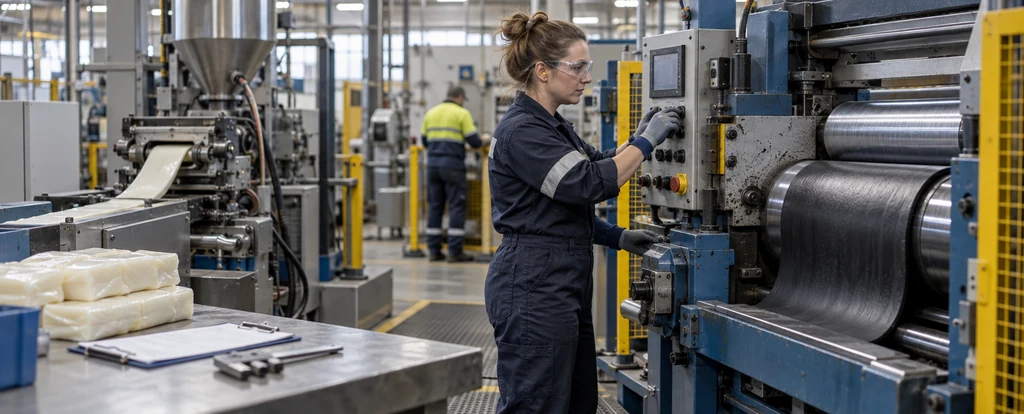
Rubber machine operators run the mixing mills, extruders and presses that turn raw rubber compound into finished parts.
- Median salary*
- $70,200
4.0%vs last year, before tax
- People employed
- 1,600
0.0%vs last year
- Projected growth*
- −3%
to 2035
- AI exposure*
- Moderate
- automation risk
- Average hours*
- 40/wk
matches all-jobs average
- Shortage status*
- Not in shortage
national
Rubber machine operators work in rubber and polymer product plants making hoses, seals, conveyor belting, mats and automotive parts. The role differs from general process work because you own the machine settings, deciding when to adjust temperature, pressure or cycle time rather than only feeding material through. Most plants run shifts, so nights and rotating rosters are common.
How much do rubber machine operators earn?
The median full-time salary for a rubber machine operator is $70,200 per annum, before tax, up $14,600 since 2018.
Pay moves with the roster: afternoon and night shifts, weekend work and overtime usually attract loadings on top of the base rate. Larger plants set rates by skill level through an enterprise agreement, so an operator who can change over moulds and sign off first-off samples earns more than someone tending a press.
What does a rubber machine operator do day to day?
The list below is what fills most weeks; the exact mix shifts with seniority and whatever stage the current work is at.
- Setting up mixing mills, extruders and moulding presses for a production run
- Feeding rubber compound into the machine and watching cycle times
- Adjusting temperature, pressure and speed controls as the compound cures
- Inspecting finished parts for defects and checking them against tolerances
- Cleaning down equipment between runs and logging output and downtime
What skills do rubber machine operators need?
Employers look for plant and equipment operation, operations management, process improvement, backed by Injection moulding machine fluency and strong attention to detail.
Specialist skills
- Plant and equipment operation
- Operations management
- Process improvement
- Worksite safety management
Software and tools
- Injection moulding machine
- Rubber extruder
- Two-roll mixing mill
- SCADA
- CMMS
General skills
- Attention to detail
- Problem solving
- Time and deadline management
Is the job growing?
About 1,600 people work as rubber machine operators in Australia, and employment is projected to decline 3% over the decade to 2035. That's a real decline, worth weighing carefully before training into the role.
How do you become a rubber machine operator?
Here's the path most rubber machine operators take, step by step.
- 1Start on a factory floor
Many operators begin as process workers, trade assistants or labourers in a rubber or plastics plant. That gives you the machine hours and the safety habits employers look for before they will put you on a press.
- 2Take a traineeship in polymer processing
A Certificate III in Polymer Processing (PMB30121) or a Certificate III in Process Manufacturing (MSM30116) covers mixing, moulding and curing, and is usually done as a traineeship so you earn while you train. It generally takes about a year to two years part time.
- 3Learn the whole line, not one machine
Operators who can set up a mill, an extruder and an injection press are far more useful to a plant than someone who knows a single station, and they are the ones considered for setter roles.
- 4Add the licences your site needs
A forklift licence is common, and some plants want high risk work licences for crane or dogging work. Site inductions and hazardous substances training come with the job.
- 5Move into setting or leading hand work
After a few years, setter and leading hand roles open up. They involve changing over moulds and dies, troubleshooting cure problems and checking that the first parts off a run meet specification.
Ready to apply as a rubber machine operator?
Whether you're working toward becoming a rubber machine operator or already are one and want a hand with the next step (sharpening your resume for ATS screening, tightening your cover letter, or knowing what you'll actually be asked at interview), here are examples grounded in this specific role, not generic templates.
What jobs can a rubber machine operator move to?
Moving into Chemical Plant Operator typically comes with the biggest pay rise, worth $36,400 a year more on average.
| Move to | Typical pay change | Overlap | Retraining |
|---|---|---|---|
| Chemical Plant Operator Rubber machine operator's mixing and curing skills suit chemical plant operation, with a short course on chemical handling and process control. | +$36,400 | 65% | short course |
| Power Station Operator Rubber machine operator brings process control and machinery monitoring skills to power generation, with a short course covering boiler and turbine systems. | +$33,800 | 78% | short course |
| Boiler Operator Rubber machine operator's experience with heating and curing rubber transfers to boiler operation, with a short course on steam systems and safety. | +$22,400 | 74% | short course |
| Concrete Pump Operator Rubber machine operator's machinery and plant operation experience applies to concrete pumping, with a short course for the required licence. | +$20,800 | 67% | short course |
| Concrete Batching Plant Operator Rubber machine operator's material handling and machine operation skills transfer directly to concrete batching, needing minimal additional training. | +$5,200 | 74% | minimal |
Moves are chosen from Jobs and Skills Australia's Data on Occupation Mobility, which follows income tax records between 2011-12 and 2020-21, together with entry requirements and skill overlap. A known move is one people were seen making in that data. Pay change compares median full-time pay for the two roles.
Who works as a rubber machine operator?
The typical rubber machine operator is 38 years old; 96% are men, 91% work full-time, and full-timers average 40 hours a week.
- 38
- Median age
- 4%
- Female share
- 91%
- Full-time
- +0h
- vs all-jobs avg
What's it like being a rubber machine operator?
The job has a steady rhythm set by the machine cycle, punctuated by the noise, heat and smell of a rubber plant. It suits someone who likes a tangible result, because you can hold the finished part in your hand at the end of a run, and who does not mind repetition and shift work to get there. The pressure arrives when a press stops or a batch cures badly, and the line waits on you to work out why.
What people like
- You can see what you made. The output is physical and countable, from a hose that holds pressure to a seal that fits first time. That is a different feeling from work that disappears into a system.
- Machines reward close attention. A small drift in temperature or cycle time shows up in the part, and tracing it back to the cause is the part of the job many operators enjoy most.
- Small teams and clear tasks. A production line usually means a handful of people working to a known sequence, so you know what is expected of you at the start of a shift.
- Skills that carry across plants. Mixing, curing and process control transfer to plastics, chemicals, concrete and power generation, which keeps your options open if the plant you work for changes hands.
What people find hard
- Heat, noise and rubber fumes. Presses and curing ovens run hot, and compounding areas are noisy and smell strongly of rubber. Hearing protection and extraction systems are standard, but the environment is still demanding.
- Long runs get repetitive. A large order can mean the same setup and the same checks for days. Some operators like the predictability, others find it tedious.
- Shift work wears on sleep. Rotating rosters that move between days, afternoons and nights disrupt sleep and social life, and plants rarely run on a Monday to Friday daytime schedule.
- Downtime pressure. When a press jams or a batch fails its hardness test, output targets do not move, and the pressure to get the line running again falls on the operator.
Based on our synthesis of professional-body surveys and public accounts of the role, not first-person verified reviews.
Which industries employ rubber machine operators?
Rubber Product Manufacturing employs the largest share of rubber machine operators, followed by Polymer Product Manufacturing.
Top employing industries
- 1Rubber Product Manufacturing
- 2Polymer Product Manufacturing
- 3Motor Vehicle Parts Manufacturing
- 4Industrial Machinery and Equipment Manufacturing
Ranked by employment share; the source doesn't publish an exact percentage per industry.
| Certificate III/IV | 34% | |
|---|---|---|
| Diploma / Advanced Diploma | 26% | |
| Bachelor degree | 20% | |
| Year 12 or below | 20% |
Will AI replace rubber machine operators?
Automation has already reshaped the machine side of this job, and it is moderately exposed overall. Programmable controls and SCADA systems now hold temperatures and cycle times steady, and vision systems check some finished parts, so fewer operators spend the day turning dials. What keeps the role grounded is the physical work around the machine: setting up a mill or press, changing over tooling, and working out why a batch cured wrong.
Share of typical working time by exposure level
- Machine setup and changeoversFitting dies and moulds, aligning feed rollers and running a first-off sample by hand is fiddly work that plants have not automated.30%low
- Monitoring the run and adjusting controlsSCADA screens now hold most settings, so operators watch trends and step in when a temperature or pressure drifts out of range.30%moderate
- Inspecting finished partsAutomated gauges and vision checks handle dimensional measurements, but operators still judge surface finish, flash and bond quality by eye and hand.20%moderate
- Fault-finding and fixing cure problemsDiagnosing a soft batch or a partly cured part means reading the machine, the compound and the run history together, which still takes an experienced operator.20%low
Moves least exposed to AI
These career moves from rubber machine operator work are rated low for AI exposure:
- Concrete Pump Operator
High skill overlap (67%), short course to get there, and a low automation-risk profile.
Common questions about becoming a rubber machine operator
Straight answers to the questions people ask most.
How much do rubber machine operators earn?
Rubber machine operators earn $70,200 per year before tax. Treat that as a guide, because shift loadings, overtime and the enterprise agreement at your site can shift take-home pay well above or below the base figure.
How do you become a rubber machine operator?
You do not need a degree. Most people start as a process worker or labourer in a rubber or plastics plant and complete a Certificate III in Polymer Processing (PMB30121) or Process Manufacturing, often as a paid traineeship, while they learn the machines.
Are rubber machine operators in demand?
Rubber machine operators are currently not in shortage, and employment is projected to decline 3% over the decade to 2035 over the decade to 2035. Vacancies tend to come up through experienced operators leaving rather than new plants opening, so hands-on machine experience and a current forklift licence help you stand out.
Will AI or automation replace rubber machine operators?
Not wholesale. Presses and extruders increasingly run from programmable controls and SCADA systems that log temperatures and cycle times, which removes some of the manual checking. Setting up a machine, changing a mould and diagnosing a bad cure still depend on feel, sound and experience, and those parts of the job are holding up.
What other jobs can a rubber machine operator move into?
The same process control and machinery monitoring skills suit power station operation, which pays around $33,800 more more, and boiler operation at $22,400 more. Chemical plant operation is another option at $36,400 more; each needs a short course covering the specific plant systems and safety rules.
Do rubber machine operators work shifts?
Yes, most do. Rubber plants often run presses around the clock, so rosters include afternoon and night shifts, and full-time operators average about 40 hours a week before overtime.
Related roles
- Power Station Operator
- Boiler Operator
- Chemical Plant Operator
- Concrete Pump Operator
- Concrete Batching Plant Operator
- Machine Operator
Not sure this is you? Take the career quiz and get a ranked shortlist of roles that fit how you like to work.