Grader Operator
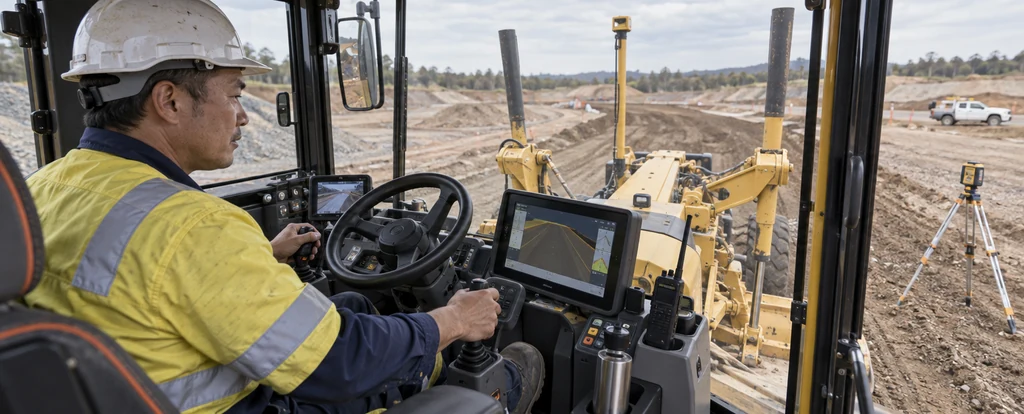
Grader operators drive a motor grader to shape and level ground so roads, pads and drainage meet the levels the plans call for.
- Median salary*
- $101,400
4.5%vs last year, before tax
- People employed
- 2,100
0.0%vs last year
- Projected growth
- +4.3%
to 2035
- AI exposure*
- Moderate
- automation risk
- Average hours
- 52/wk
+12h vs all jobs
- Shortage status
- In shortage
national
Grader operators work on civil construction sites, road maintenance crews and mine sites, spending most of the shift at the controls and adjusting the blade to hold a level or a slope. What sets the job apart from other plant work is precision: an excavator moves bulk material, while a grader finishes a surface to within tight tolerances. Employers usually want a grader competency, a White Card and recent machine hours, and much of the work is outdoors on projects away from home.
How much do grader operators earn?
The median full-time salary for a grader operator is $101,400 per annum, before tax, up $21,500 since 2018.
Pay depends heavily on the sector and the agreement covering it. Graders on mine sites and large civil projects usually earn more than those on local council road crews, and site allowances, project bonuses and roster patterns add to the total. Operators who can run GPS machine control confidently are the ones offered the better paid jobs.
What does a grader operator do day to day?
The list below is what fills most weeks; the exact mix shifts with seniority and whatever stage the current work is at.
- Running the grader across a site to cut, spread and level material
- Reading plans, grade stakes and survey marks to set blade depth, angle and slope
- Shaping subgrade, shoulders, drains and batters to the design levels, with levels checked against survey setout
- Working over the radio with truck drivers, roller operators and surveyors to keep the sequence moving
- Doing pre-start checks, greasing and basic maintenance on the machine and reporting faults to the fitter
What skills do grader operators need?
Employers look for plant and equipment operation, worksite safety management, reading plans and specifications, backed by Motor grader (CAT, John Deere) fluency and strong attention to detail.
Specialist skills
- Plant and equipment operation
- Worksite safety management
- Reading plans and specifications
Software and tools
- Motor grader (CAT, John Deere)
- GPS machine control (Trimble Earthworks, Topcon 3D-MC)
- Laser level
- Two-way radio
- Hand tools
General skills
- Attention to detail
- Problem solving
- Time and deadline management
Is the job growing?
About 2,100 people work as grader operators in Australia, and employment is projected to grow 4.3% over the decade to 2035. That's modest growth: demand is steady rather than booming.
How do you become a grader operator?
Here's the path most grader operators take, step by step.
- 1Get your White Card
The general construction induction card is required before you can work on most construction sites, and the training takes about a day.
- 2Build machine and site experience
Most grader operators start on a roller, water cart or excavator, or as a civil construction labourer. That time teaches you how a site runs, what the other crews need and how ground and material behave.
- 3Complete grader training through a registered training organisation
A short course and practical assessment in civil construction grader operations leads to a statement of attainment, and some providers deliver it on your employer's machine.
- 4Prove your hours and pass a verification of competency
Employers check recent grader hours and often run their own verification of competency on the machine you will drive, since there is no national high risk work licence for graders.
- 5Add GPS machine control skills
Learning Trimble, Topcon or similar 3D machine control opens up finishing and large-project work, and it is usually picked up on the job.
Ready to apply as a grader operator?
Whether you're working toward becoming a grader operator or already are one and want a hand with the next step (sharpening your resume for ATS screening, tightening your cover letter, or knowing what you'll actually be asked at interview), here are examples grounded in this specific role, not generic templates.
What jobs can a grader operator move to?
Moving into Bulldozer Operator typically comes with the biggest pay rise, worth $5,200 a year more on average.
| Move to | Typical pay change | Overlap | Retraining |
|---|---|---|---|
| Bulldozer Operator Operating a bulldozer builds on the same earthmoving skills, so grader operators can step up to heavier machinery with minimal retraining. | +$5,200 | 69% | minimal |
| Earthmoving Plant Operator Grader operators bring precise grading skills and machinery tickets to general earthmoving work, moving across with little retraining.Known move | +$1,600 | 79% | minimal |
| Excavator Operator Excavator operation uses the same site machinery experience, letting grader operators switch to digging and lifting work. | −$2,600 | 61% | minimal |
| Backhoe Operator A backhoe operator role suits grader operators who want to add digging and loading to their earthmoving skill set. | −$2,600 | 61% | minimal |
| Roller Operator Grader operators can move to roller operation, applying their compaction and surface knowledge to a closely related plant role. | −$5,200 | 69% | minimal |
Moves are chosen from Jobs and Skills Australia's Data on Occupation Mobility, which follows income tax records between 2011-12 and 2020-21, together with entry requirements and skill overlap. A known move is one people were seen making in that data. Pay change compares median full-time pay for the two roles.
Who works as a grader operator?
The typical grader operator is 52 years old; 97% are men, 92% work full-time, and full-timers average 52 hours a week.
- 52
- Median age
- 3%
- Female share
- 92%
- Full-time
- +12h
- vs all-jobs avg
What's it like being a grader operator?
The work follows a project schedule rather than a fixed day, so shifts are long and starts are early, often with travel or a roster away from home. Most of the shift is spent alone in the cab in radio contact with trucks, rollers and surveyors, and the pressure comes from holding tolerance while everyone else works around you. It suits people who like machinery, can concentrate for long stretches and take pride in a surface that comes out right.
What people like
- A finished surface you can point to. Grading leaves the finished surface behind, so holding a road or pad to the design levels is a visible measure of how the day went.
- Working without close supervision. Once you are set up with the plan and the setout, you decide how to work the material and when to adjust the blade, with the supervisor checking in by radio.
- Projects that run for years. Road upgrades, subdivisions and mine expansions keep graders busy for long stretches, so you can stay on one project or follow the work around the state.
- The variety of ground you work. One week you are trimming a subdivision road, the next you are cutting a drainage batter or finishing a haul road, and each material behaves differently under the blade.
What people find hard
- Long shifts and time in camp. A full-time week averages 52 hours, and rosters on remote projects add travel on top, which is hard on family life.
- Wet weather stops the job. Grading wet material does more harm than good, so rain can cancel a shift at short notice and push the whole program back.
- Concentration that never lets up. Holding a blade on grade for hours at a time is tiring, and a lapse in attention shows up immediately in the surface behind you.
- Waiting on the crews around you. Grading depends on trucks delivering material and rollers compacting it, so part of the day goes on waiting for the sequence to come back to you.
Based on our synthesis of professional-body surveys and public accounts of the role, not first-person verified reviews.
Which industries employ grader operators?
Construction employs the largest share of grader operators, followed by Public Administration and Safety.
Top employing industries
- 1Construction
- 2Public Administration and Safety
- 3Mining
Ranked by employment share; the source doesn't publish an exact percentage per industry.
| Year 12 or below | 62% | |
|---|---|---|
| Certificate III/IV | 30.4% | |
| Diploma / Advanced Diploma | 1.7% | |
| Bachelor degree | 0.5% | |
| Postgraduate | 0% |
Will AI replace grader operators?
Machine control has already reshaped the job: GPS and 3D systems set blade height and slope from the design model, so the operator follows a screen rather than working from grade stakes. The blade itself still needs a person with a feel for how the material is moving, and the machine still needs positioning, checking and calls about what to do next. That puts the overall exposure in the moderate range, concentrated in grade setting rather than in running the machine.
Share of typical working time by exposure level
- Cutting, spreading and finishing materialSoftware guides the blade, but the operator still judges how the material is behaving, when to take another pass and how to blend into what is already on the ground.30%moderate
- Setting grade from plans and survey marksGPS and 3D machine control now derive blade height and slope from the design model, which removes most of the offset arithmetic operators once did from stakes.25%high
- Keeping the site sequence moving over the radioTalking truck drivers, roller operators and surveyors through their part of the job, and knowing when to hold off grading, comes down to reading people and the site at the same time.25%moderate
- Pre-start checks and machine careWalking around the machine, checking oil, coolant and grease points, and telling the fitter what is rattling is hands-on work that sensors only partly cover.20%low
Moves least exposed to AI
These career moves from grader operator work are rated low for AI exposure:
- Bulldozer Operator
High skill overlap (69%), little retraining to get there, and a low automation-risk profile.
- Backhoe Operator
High skill overlap (61%), little retraining to get there, and a low automation-risk profile.
Common questions about becoming a grader operator
Straight answers to the questions people ask most.
How much does a grader operator earn?
Grader operators earn $101,400 per year before tax at the median for full-time work. What you are offered depends on the sector and the enterprise agreement: mine sites and large civil projects pay more than council road crews, and site allowances and roster arrangements change the total. Treat the median as the middle of the range rather than a starting offer.
How do you become a grader operator?
You need a White Card, a grader competency and enough machine hours to be trusted with the blade. Most operators get there by working other plant first, such as a roller or an excavator, then completing a short course and practical assessment through a registered training organisation. Employers usually ask for a verification of competency on their own machine before you start.
Are grader operators in demand?
Grader operators are currently in shortage nationally, and employment is projected to grow 4.3% over the decade to 2035 over the decade to 2035. Road programs, subdivisions and mine work keep grader hours steady, so a current competency and recent machine time matter more to employers than the overall number.
Will AI or automation replace grader operators?
Machine control has already changed the job, because GPS and 3D systems set blade height from the design model instead of from grade stakes. The blade still needs someone with a feel for the material, and the machine still needs positioning, checking and judgement about what the ground will do. Overall the exposure is moderate, with the grade-setting side of the work most affected.
What other jobs can a grader operator move into?
Grader operators often shift into other earthmoving plant work. Earthmoving plant operator is a common move with overlapping skills and pay $1,600 more, and bulldozer operator is a step up in machine size at $5,200 more. Some experienced operators eventually buy their own machine and contract it out, which is where earnings can grow.
Do you need a licence to operate a grader?
There is no national high risk work licence for graders, so the requirement is a statement of attainment in grader operations plus a White Card. Most employers then run their own verification of competency on the machine you will drive. A heavy vehicle licence helps on sites where you also move the float or the machine between jobs.
Specialisation of
Related roles
- Earthmoving Plant Operator
- Bulldozer Operator
- Roller Operator
- Excavator Operator
- Backhoe Operator
- Earthmoving Plant Operator
Not sure this is you? Take the career quiz and get a ranked shortlist of roles that fit how you like to work.