School Crossing Supervisor
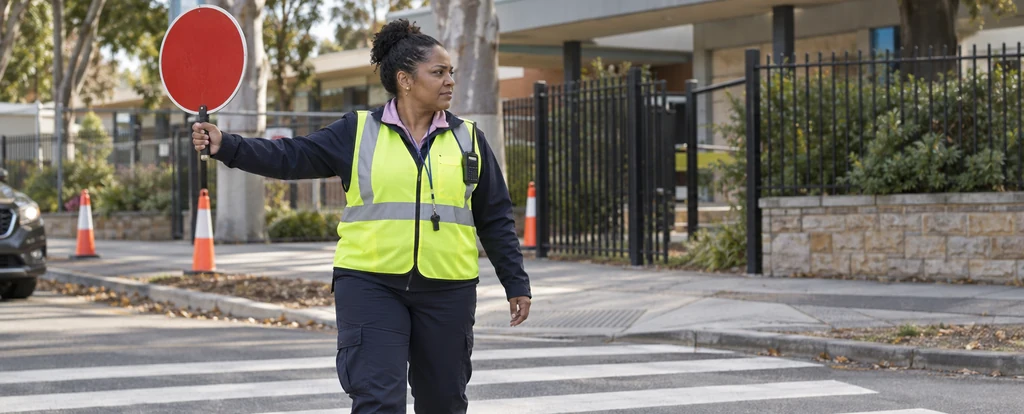
School crossing supervisors stop traffic at marked crossings so children can get to and from school safely.
- Median salary*
- $49,400
4.4%vs last year, before tax
- People employed
- 6,300
0.0%vs last year
- Projected growth
- +4.2%
to 2035
- AI exposure*
- Low
- automation risk
- Average hours
- 26/wk
−14h vs all jobs
- Shortage status*
- Not in shortage
national
School crossing supervisors work at marked crossings outside primary schools, usually on a local council payroll, in a short shift before the first bell and another at the end of the day. The job is different from traffic control at roadworks: it runs on the school clock rather than a construction schedule, and it involves the same children and parents every week. Most positions are part-time and term-time only, which is why the role attracts people who want short hours close to home.
How much do school crossing supervisors earn?
The median full-time salary for a school crossing supervisor is $49,400 per annum, before tax, up $10,400 since 2018.
Pay comes from the relevant local government award or a council enterprise agreement, and casual or relief shifts usually attract a loading on top. Rates differ between councils and states, so the hourly figure is set by who employs you rather than by the crossing itself. Because the work is split into a short morning and afternoon shift and stops for school holidays, weekly earnings depend on how many crossings you cover.
What does a school crossing supervisor do day to day?
The list below is what fills most weeks; the exact mix shifts with seniority and whatever stage the current work is at.
- Stopping traffic with a stop bat so groups of children can cross
- Waiting with students at the kerb until cars have actually stopped
- Watching turning cars, driveways and parked vehicles while a crossing is in progress
- Greeting parents, students and regular drivers, which keeps the crossing predictable
- Logging near misses, worn signs or blocked sightlines and passing them to the council
What skills do school crossing supervisors need?
Employers look for community engagement, backed by Stop/slow bat fluency and strong written communication.
Specialist skills
- Community engagement
Software and tools
- Stop/slow bat
- High-visibility vest
- Two-way radio
- Whistle
- Traffic cones
General skills
- Written communication
- Attention to detail
- Safety and compliance awareness
- Customer service
- Problem solving
- Physical stamina and dexterity
Is the job growing?
About 6,300 people work as school crossing supervisors in Australia, and employment is projected to grow 4.2% over the decade to 2035. That's modest growth: demand is steady rather than booming.
How do you become a school crossing supervisor?
Here's the path most school crossing supervisors take, step by step.
- 1Ask your local council
Crossing supervisors are usually employed by councils, or by the state road or education authority in some places, and vacancies are advertised on council websites and school noticeboards, often before the school year starts.
- 2Get your working with children clearance
A Working with Children Check is required in most states, known as the Blue Card in Queensland or the Ochre Card in the Northern Territory, and a police check is often part of the same process.
- 3Complete the council induction
Training is paid and practical, covering where to stand, how to use the stop bat and how to report an incident. No formal qualification is needed, though a first aid certificate can strengthen an application.
- 4Start with relief work
Relief supervisors cover absences across several crossings, which builds experience quickly and is often how people end up with a permanent crossing near home.
Ready to apply as a school crossing supervisor?
Whether you're working toward becoming a school crossing supervisor or already are one and want a hand with the next step (sharpening your resume for ATS screening, tightening your cover letter, or knowing what you'll actually be asked at interview), here are examples grounded in this specific role, not generic templates.
What jobs can a school crossing supervisor move to?
Moving into Cleaner typically comes with the biggest pay rise, worth $20,400 a year more on average.
| Move to | Typical pay change | Overlap | Retraining |
|---|---|---|---|
| Cleaner The role builds on reliability and safety awareness, though formal cleaning training or a certificate is needed.Known move | +$20,400 | 42% | reskill |
| Teacher Aide Experience supervising children in a school setting carries across, but a teacher aide certificate or qualification is needed.Known move | +$20,400 | 14% | reskill |
| Traffic Controller Road safety experience and managing crossings carry over, but a traffic control ticket and training are required.Known move | +$15,600 | 33% | reskill |
Moves are chosen from Jobs and Skills Australia's Data on Occupation Mobility, which follows income tax records between 2011-12 and 2020-21, together with entry requirements and skill overlap. A known move is one people were seen making in that data. Pay change compares median full-time pay for the two roles.
Who works as a school crossing supervisor?
The typical school crossing supervisor is 64 years old; 60% are women, 1% work full-time, and full-timers average 26 hours a week.
- 64
- Median age
- 60%
- Female share
- 1%
- Full-time
- −14h
- vs all-jobs avg
What's it like being a school crossing supervisor?
The job runs on the school day, with a short shift before the first bell and another as students leave, so supervisors are finished not long after the last children cross. You work alone at your crossing in whatever the weather is doing, and the decisions are quick ones about gaps in traffic. It suits someone steady and alert who likes a settled routine and knows the local families, rather than anyone after full days or a changing workload.
What people like
- Shifts that leave most of the day free. The morning and afternoon shifts are short, so the hours in between belong to you.
- You know the people you see. The same families cross with you each week, and children often greet you by name.
- The crossing is close to home. Most supervisors live a short walk or drive from the school they cover, which keeps travel time and costs down.
- Time off in the school holidays. The breaks line up with school terms, which is hard to find in most part-time work.
What people find hard
- You are outside in everything. Many crossings have little shelter, so rain, wind and summer heat are simply part of the shift.
- Not every driver stops. Supervisors deal with drivers who roll through, ignore the bat or yell at them, and reporting the vehicle afterwards is about the only recourse.
- School holidays are unpaid. The work is term-time, so income stops for the breaks unless you pick up shifts elsewhere.
- The responsibility sits with you alone. You are the only person at the crossing, and the safety of the children in front of you rests on your reading of the traffic.
Based on our synthesis of professional-body surveys and public accounts of the role, not first-person verified reviews.
Which industries employ school crossing supervisors?
Public Administration and Safety employs the largest share of school crossing supervisors, followed by Transport, Postal and Warehousing.
Top employing industries
- 1Public Administration and Safety
- 2Transport, Postal and Warehousing
- 3Education and Training
Ranked by employment share; the source doesn't publish an exact percentage per industry.
| Year 12 or below | 55.1% | |
|---|---|---|
| Certificate III/IV | 17.1% | |
| Diploma / Advanced Diploma | 8.6% | |
| Bachelor degree | 7.5% | |
| Postgraduate | 3.7% |
Will AI replace school crossing supervisors?
Low. The core task is standing in the road and reading traffic, and automation does not do that: flashing school zone signs and speed cameras warn drivers, but a person still has to step out and stop them. Councils use rostering software to fill relief shifts and online forms for incident reports, which changes the admin around the job rather than the crossing itself.
Share of typical working time by exposure level
- Stopping traffic and walking children acrossJudging a safe gap and stepping into the road with a stop bat happens in real time, and no sign or sensor makes that call.45%low
- Watching traffic while a crossing is in progressYou are checking turning cars, driveways and parked vehicles at the same time as the children in front of you.25%low
- Reporting hazards and incidentsCouncil apps and online forms have replaced paper logs, so the record keeping is quicker but still written by the supervisor.15%moderate
- Setting up signs and coordinating with the schoolCollecting the equipment, checking the crossing before students arrive and letting the school office know if something is wrong.15%low
Common questions about becoming a school crossing supervisor
Straight answers to the questions people ask most.
How much do school crossing supervisors earn?
School crossing supervisors earn a median of $49,400 per year before tax, based on full-time hours. Most positions are part-time and term-time, so take-home pay depends on the shifts a council offers you and the hourly rate in the relevant award or enterprise agreement.
How do you become a school crossing supervisor?
Apply to your local council, which usually employs crossing supervisors directly, and complete a Working with Children Check plus a short paid induction. No formal qualification is required, and the training covers stop bat use, positioning and incident reporting. Many people start with relief shifts before taking a permanent crossing.
Are school crossing supervisors in demand?
School crossing supervisors are currently not in shortage, and employment is projected to grow 4.2% over the decade to 2035. Hiring follows school enrolments and council budgets, so vacancies come up locally rather than in statewide rounds. It is worth checking your council's listings periodically if you have a particular school in mind.
Could AI replace school crossing supervisors?
Low. Automatic flashing signs and school zone speed cameras warn drivers, but someone still has to step onto the road and stop traffic, and that judgement is made in real time with children waiting. Councils use rostering apps to fill relief shifts and online forms for incident reports, which changes the paperwork rather than the job.
What are the hours like?
Shifts are short and split, roughly an hour before school and an hour after, on school days only. Full-time hours average 26 a week across those shifts, and many positions are part-time. The long gap in the middle of the day is unpaid, so it suits people who want a short working day.
What jobs can a school crossing supervisor move into?
Traffic control builds on the same road sense and safety habits, and it needs a traffic control licence and training first; traffic controllers earn $15,600 more. Cleaning is another option with similar shift work and less public contact, and cleaners earn $20,400 more. A teacher aide role keeps you in a school, though it needs a certificate in education support, and teacher aides earn $20,400 more.
Related roles
Not sure this is you? Take the career quiz and get a ranked shortlist of roles that fit how you like to work.