Traffic Controller
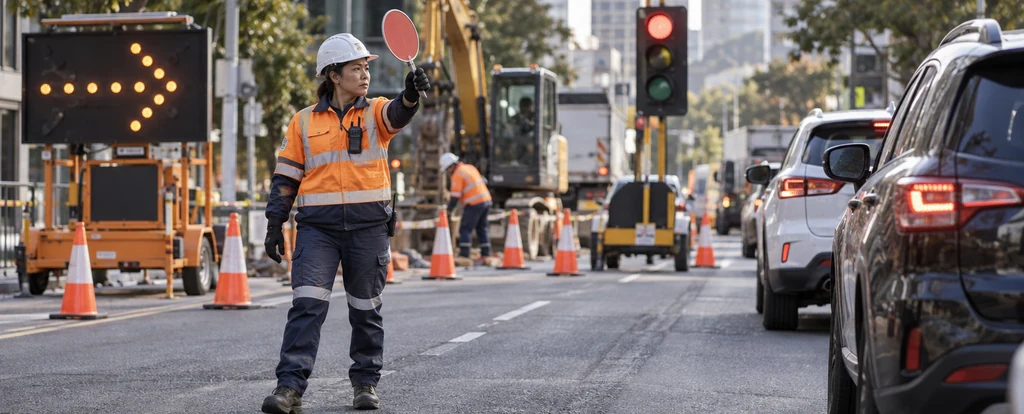
Traffic controllers direct vehicles and pedestrians past roadworks, crashes and events so that road users and work crews get through safely.
- Median salary*
- $65,000
3.5%vs last year, before tax
- People employed
- 16,100
0.0%vs last year
- Projected growth
- +4.2%
to 2035
- AI exposure*
- Moderate
- automation risk
- Average hours
- 45/wk
+5h vs all jobs
- Shortage status*
- In shortage (regional)
national
Traffic controllers work on roads, at intersections and around public events, usually as part of a small crew run by a traffic management company or a civil contractor. They set out the temporary traffic layout on site and then work inside it, while the plan itself is designed beforehand by an accredited traffic management planner or engineer. The work is outdoors in every season, and because lane closures are often scheduled outside peak hours, shifts can fall at night or on weekends.
How much do traffic controllers earn?
The median full-time salary for a traffic controller is $65,000 per annum, before tax, up $13,800 since 2018.
What you take home depends heavily on the award or enterprise agreement you are employed under, and the same work can pay quite differently between a casual labour hire placement and a permanent crew with a council or state road authority. Penalty rates do a lot of the work here, because lane closures are often scheduled at night and on weekends, and casual loading adds to the hourly rate instead of paid leave. Travel and remote project allowances can also lift the rate on regional jobs away from home.
What does a traffic controller do day to day?
The list below is what fills most weeks; the exact mix shifts with seniority and whatever stage the current work is at.
- Setting out signs, cones, barriers and portable traffic lights to match the traffic control plan
- Directing vehicles and pedestrians with a stop/slow bat and hand signals, sometimes for hours at a time
- Talking with crews and supervisors over two-way radio as lanes close, open or shift
- Watching traffic flow and adjusting lane closures or detours when queues start to build
- Reporting hazards, incidents and near misses to the site supervisor before the shift ends
What skills do traffic controllers need?
Employers look for worksite safety management, operations management, backed by Stop/slow bat fluency and strong written communication.
Specialist skills
- Worksite safety management
- Operations management
Software and tools
- Stop/slow bat
- Two-way radio
- Portable traffic lights
- Arrow board
- RapidPlan
General skills
- Written communication
- Attention to detail
- Safety and compliance awareness
- Problem solving
- Customer service
Is the job growing?
About 16,100 people work as traffic controllers in Australia, and employment is projected to grow 4.2% over the decade to 2035. That's modest growth: demand is steady rather than booming.
How do you become a traffic controller?
Here's the path most traffic controllers take, step by step.
- 1Complete the traffic control skill set
The entry qualification is a short nationally recognised course covering controlling traffic with a stop/slow bat and with portable traffic control devices, usually delivered over one or two days by a registered training organisation.
- 2Get a White Card
A general construction induction card is required before you can work on most construction sites, and it takes a short course of its own. Without it, you are limited to the roads and events where no site induction applies.
- 3Check your state's accreditation requirement
Most states require a traffic controller to hold a state-issued card or accreditation on top of the training, and the application steps and renewal periods differ between states, so check with the road authority where you plan to work.
- 4Start with a traffic management company
Most new controllers get their first shifts through a traffic management firm or a civil contractor, often casually or via labour hire. The first few months on live roads are where you learn to read traffic rather than just follow a plan.
- 5Build towards implementer or designer qualifications
A traffic management implementer or designer course lets you plan and set up layouts rather than only work inside them, which is the usual route to steadier and better-paid work.
Ready to apply as a traffic controller?
Whether you're working toward becoming a traffic controller or already are one and want a hand with the next step (sharpening your resume for ATS screening, tightening your cover letter, or knowing what you'll actually be asked at interview), here are examples grounded in this specific role, not generic templates.
What jobs can a traffic controller move to?
Moving into Earthmoving Plant Operator typically comes with the biggest pay rise, worth $38,000 a year more on average.
| Move to | Typical pay change | Overlap | Retraining |
|---|---|---|---|
| Earthmoving Plant Operator Traffic controllers work beside plant on road projects, so they can progress to earthmoving plant operation with tickets.Known move | +$38,000 | 33% | reskill |
| Truck Driver Traffic controllers already read road conditions and work around heavy vehicles, so they can move into truck driving with reskilling.Known move | +$36,900 | 22% | reskill |
| Train Controller Traffic controllers coordinate vehicle movements and safety, giving a base for the control room duties of a train controller. | +$36,400 | 39% | reskill |
| Roller Operator Traffic controllers understand compaction and roadwork zones, so they can take a short course to operate a roller. | +$31,200 | 53% | short course |
| Loader Operator Traffic controllers know site traffic flow and safety, so they can train briefly to operate a loader. | +$29,600 | 50% | short course |
Moves are chosen from Jobs and Skills Australia's Data on Occupation Mobility, which follows income tax records between 2011-12 and 2020-21, together with entry requirements and skill overlap. A known move is one people were seen making in that data. Pay change compares median full-time pay for the two roles.
Who works as a traffic controller?
The typical traffic controller is 43 years old; 67% are men, 52% work full-time, and full-timers average 45 hours a week.
- 43
- Median age
- 33%
- Female share
- 52%
- Full-time
- +5h
- vs all-jobs avg
What's it like being a traffic controller?
A shift is mostly standing: you are on your feet in the weather, holding a bat or working the radio, watching traffic you cannot control. The days can be long and the shifts irregular, but the work is concrete, the crew is small, and there is a clear difference between a shift that went fine and one that did not. It suits people who are comfortable being visible and making a call in front of a queue of drivers.
What people like
- You can see the job done. By the end of a shift the signs are packed up and the road is running again, so the result of the day's work is visible in a way a lot of jobs are not.
- Outdoors and on your feet. The work suits people who would rather be on a site than at a desk, even when the weather is against them.
- A short path in. Training takes days rather than years, so you can be earning on a road crew within weeks of deciding to do it.
- Small crews with clear roles. You work with a handful of people who depend on each other, and the radio keeps everyone in contact through the shift.
What people find hard
- Standing in the weather. Heat, rain and cold are part of the job, and on extreme days a site can shut down, which cuts the shift short and the pay with it.
- Abuse from drivers. Delays make some drivers angry, and the person holding the bat is the one they see, which is why crews often work with a supervisor or police nearby.
- Irregular hours. Lane closures are often scheduled at night or on weekends, and rain can move a shift at short notice, which makes planning around family or study difficult.
- Project-based work. Much of the work is hired by the day or for the life of a project, so income can stop between jobs unless you have built a name with a few contractors.
Based on our synthesis of professional-body surveys and public accounts of the role, not first-person verified reviews.
Which industries employ traffic controllers?
Public Administration and Safety employs the largest share of traffic controllers, followed by Construction.
Top employing industries
- 1Public Administration and Safety
- 2Construction
- 3Professional, Scientific and Technical Services
Ranked by employment share; the source doesn't publish an exact percentage per industry.
| Year 12 or below | 53.5% | |
|---|---|---|
| Certificate III/IV | 24.5% | |
| Diploma / Advanced Diploma | 7.6% | |
| Bachelor degree | 5.4% | |
| Postgraduate | 1.4% |
Will AI replace traffic controllers?
Traffic control is partly exposed to AI, and mostly at the edges of the job. Rostering, traffic counting and the diagrams behind a traffic management plan are increasingly produced by software, which changes how the paperwork is done but not who stands on the road. The core task, reading drivers and deciding when to stop and release a live lane, is physical, immediate and unpredictable, and no current system does it.
Share of typical working time by exposure level
- Holding the stop/slow batYou turn the bat on a car that hasn't begun to slow, or hold a lane while a truck backs out of a driveway, judging each one by how the driver is approaching and how far the queue behind is stretching.40%low
- Setting out and packing up the sitePlacing and checking signs, cones and portable traffic lights is hands-on work in the weather, guided by a plan but adjusted to how the road actually sits.25%low
- Checking the plan against the roadDesign software such as RapidPlan generates the layout, but noticing that a driveway or bus stop does not fit the diagram as drawn is still a call made on site.20%moderate
- Recording counts and incidentsVehicle counts, delay times and incident notes at the end of a shift are increasingly captured by automatic counters and phone apps rather than a clipboard.15%moderate
Moves least exposed to AI
These career moves from traffic controller work are rated low for AI exposure:
- Loader Operator
Solid skill overlap (50%), short course to get there, and a low automation-risk profile.
Common questions about becoming a traffic controller
Straight answers to the questions people ask most.
How much do traffic controllers earn?
Traffic controllers earn a median of $65,000 per year before tax, which reflects a mix of permanent, casual and project-based workers rather than a starting rate. What you actually take home moves with the award or enterprise agreement you are on, the penalty rates for night and weekend work, and whether you are paid casual loading.
How do I become a traffic controller?
You start with a short nationally recognised traffic control course, add a White Card for construction sites, and then meet whichever accreditation your state's road authority requires. Most new controllers get their first shifts through a traffic management company or a labour hire firm, which is where the practical reading of traffic is learned.
Are traffic controllers in demand?
Traffic controllers are currently in shortage in regional areas, and employment is projected to grow 4.2% over the decade to 2035. Demand follows road and infrastructure projects rather than the wider economy, so it is worth checking what major road work is scheduled in the area you want to work in.
Will AI replace traffic controllers?
The most exposed parts of the job are the ones done on a screen: rostering, traffic counts and the diagrams behind a traffic management plan, and some of that is already automated. The core of the work is not. Standing in a live lane, judging whether a driver has seen the signs and deciding when to release a queue is physical, immediate and unpredictable, and no system does it.
What can a traffic controller move on to?
Traffic control sits beside several better-paid jobs. Truck driving builds on the road sense you already use and pays $36,900 more, earthmoving plant operation pays $38,000 more and needs a short licensing course, and train control pays $36,400 more while drawing on the same habit of moving vehicles to a plan. Some controllers instead start their own traffic management business or run a crew, which is often where earnings grow.
What are the hours like?
Full-time traffic controllers average 45 hours a week, and much of the work happens when the road can be closed, which means night shifts, weekends and early starts. Rain and extreme weather can also push a shift to another day at short notice.
Related roles
- Truck Driver
- Train Controller
- Earthmoving Plant Operator
- Roller Operator
- Loader Operator
- Civil Construction Labourer
Not sure this is you? Take the career quiz and get a ranked shortlist of roles that fit how you like to work.