Vehicle Trimmer
Vehicle trimmers cut, sew and fit the fabric, leather, vinyl and foam that make up a vehicle's interior.
- Median salary*
- $70,200
3.5%vs last year, before tax
- People employed
- 1,300
0.0%vs last year
- Projected growth
- +2.5%
to 2035
- AI exposure*
- Moderate
- automation risk
- Average hours
- 43/wk
+3h vs all jobs
- Shortage status
- In shortage
national
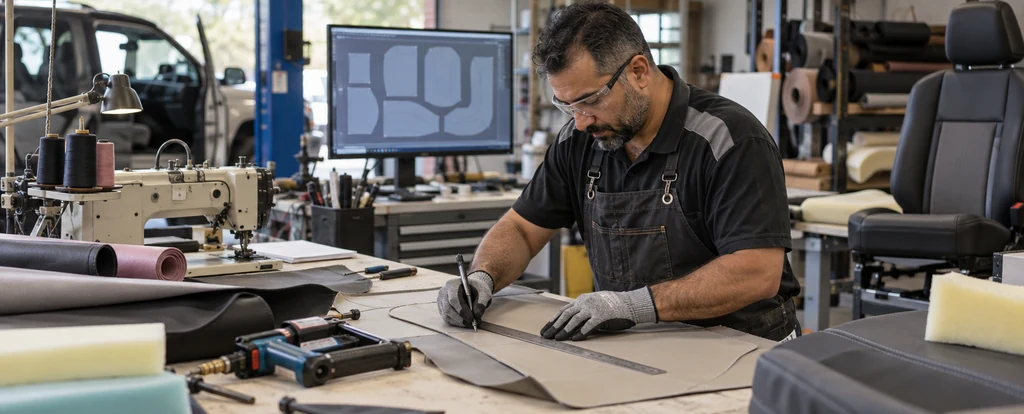
Vehicle trimmers work in automotive repair workshops, specialist trimming businesses and vehicle manufacturing plants, mostly on seats, door trims, headlinings and carpets. Most of what they make is cut and sewn from scratch, then stretched and shaped to fit a frame or a body shell, which is what separates the trade from general automotive fitting. Trimming shops tend to be small teams, and a lot of the work arrives through insurance repairs, restoration projects and custom builds.
How much do vehicle trimmers earn?
The median full-time salary for a vehicle trimmer is $70,200 per annum, before tax, up $14,900 since 2018.
What you earn depends on the award or enterprise agreement covering your workplace and on how much overtime and penalty rate work you pick up. A trade qualification plus experience in high-end custom, restoration or marine trimming usually pays better than production line work, and small shops vary widely in what they can offer. Location matters mainly through the local mix of industries, whether that is a manufacturing plant or a steady stream of restoration jobs.
What does a vehicle trimmer do day to day?
The list below is what fills most weeks; the exact mix shifts with seniority and whatever stage the current work is at.
- Measuring and marking patterns for seat covers, trim panels and carpets
- Cutting fabric, leather, vinyl and foam by hand or with foam cutting equipment
- Sewing panels and covers on an industrial sewing machine
- Stretching and stapling covers and padding onto seat frames, door trims and dashboards
- Repairing or replacing worn headlinings, carpets and trim, which is much of the insurance and restoration work
What skills do vehicle trimmers need?
Employers look for craft and handmade production, hand and power tool work, backed by Industrial sewing machine fluency and strong attention to detail.
Specialist skills
- Craft and handmade production
- Hand and power tool work
Software and tools
- Industrial sewing machine
- Foam cutting equipment
- Pneumatic staple gun
- Hand and power tools
- Pattern drafting software
General skills
- Attention to detail
- Problem solving
- Written communication
- Time and deadline management
Is the job growing?
About 1,300 people work as vehicle trimmers in Australia, and employment is projected to grow 2.5% over the decade to 2035. That's modest growth: demand is steady rather than booming.
How do you become a vehicle trimmer?
Here's the path most vehicle trimmers take, step by step.
- 1Try a Certificate II in Automotive Vocational Preparation
A short TAFE course in automotive basics is a low-commitment way to find out whether you like workshop work, and it can help you win an apprenticeship. It is not required to enter the trade.
- 2Start an apprenticeship in automotive trimming
The standard entry is an Australian Apprenticeship, usually three to four years, combining paid on-the-job training with a Certificate III in Automotive and Marine Trimming Technology (AUR32320) at TAFE or a registered training organisation.
- 3Finish the trade qualification
Most employers expect the Certificate III, and the qualification is what lets you work unsupervised and move between shops. Trimming is not a licensed trade, so there is no separate registration to apply for.
- 4Specialise
After the apprenticeship, trimmers often settle into one area such as marine and caravan upholstery, classic restoration, aviation interiors or production work, since each needs different materials and methods.
- 5Move into custom or workshop roles
With experience, trimmers take on whole custom interiors or move into a head trimmer role, and some eventually open their own trimming or upholstery business. Coming from a related job such as car detailing or dismantling usually still means completing the apprenticeship to build upholstery skills.
Ready to apply as a vehicle trimmer?
Whether you're working toward becoming a vehicle trimmer or already are one and want a hand with the next step (sharpening your resume for ATS screening, tightening your cover letter, or knowing what you'll actually be asked at interview), here are examples grounded in this specific role, not generic templates.
What jobs can a vehicle trimmer move to?
Moving into Vehicle Body Builder typically comes with the biggest pay rise, worth $5,200 a year more on average.
| Move to | Typical pay change | Overlap | Retraining |
|---|---|---|---|
| Vehicle Body Builder Vehicle trimmers apply their fabrication and fitting experience to building vehicle bodies, a step up that uses shared automotive construction skills. | +$5,200 | 36% | reskill |
| Orthotic and Prosthetic Technician Vehicle trimmers bring custom fabrication, cutting and fitting skills to orthotic and prosthetic work, where hand-shaped devices need precise finishing. | +$2,600 | 64% | short course |
| Vehicle Accessories Fitter Vehicle trimmers bring fitting and finishing skills to accessory installation, moving into a role that shares automotive interior and exterior work.Known move | −$5,200 | 31% | reskill |
| Window Tinter Vehicle trimmers transfer precision fitting and surface preparation to window tinting, an automotive specialism with similar hand skills. | −$5,200 | 35% | reskill |
| Auto Glazier Vehicle trimmers move into auto glazing, using their experience with vehicle interiors and fitting to install and seal glass. | −$5,200 | 28% | reskill |
Moves are chosen from Jobs and Skills Australia's Data on Occupation Mobility, which follows income tax records between 2011-12 and 2020-21, together with entry requirements and skill overlap. A known move is one people were seen making in that data. Pay change compares median full-time pay for the two roles.
Who works as a vehicle trimmer?
The typical vehicle trimmer is 48 years old; 91% are men, 76% work full-time, and full-timers average 43 hours a week.
- 48
- Median age
- 9%
- Female share
- 76%
- Full-time
- +3h
- vs all-jobs avg
What's it like being a vehicle trimmer?
The week follows whatever is in the workshop: a run of insurance repairs, then a restoration or custom interior that takes weeks and only leaves when the fit is right. It is physical, hands-on work with foam dust, adhesives and sewing machines, and the result is visible to everyone who gets into the vehicle. Trimmers who enjoy the craft and the independence of a small shop tend to get the most out of it.
What people like
- You finish something you can see. A seat or headlining you patterned, sewed and fitted goes back into a vehicle and stays there, so the quality of your work is obvious to the customer and to you.
- Every vehicle is a different shape. Insurance repairs, restorations and custom builds all call for fresh patterns and problem solving rather than repeating one job, especially in a shop that takes on older or unusual vehicles.
- The skills carry across materials. Cutting, shaping and fitting techniques transfer to marine and caravan upholstery, furniture and other trimming work, which gives you options if automotive work slows.
- Small teams and a fair bit of autonomy. In a trimming shop you often take a job from pattern through to final fit, with less supervision than you would have on a production line.
What people find hard
- Dusty, physical conditions. Foam dust, spray adhesive and long stretches either bent over a seat frame or sitting at a sewing machine are part of the job, and a workshop is a workshop.
- Deadline pressure on promised jobs. A customer is waiting for a vehicle, and a cover that does not sit right has to be pulled apart and remade, which pushes the rest of the week back.
- Repetition in production work. Trimming on a manufacturing line means the same seat pattern and the same sequence all day, which suits some people and wears others down.
Based on our synthesis of professional-body surveys and public accounts of the role, not first-person verified reviews.
Which industries employ vehicle trimmers?
Other Services employs the largest share of vehicle trimmers, followed by Manufacturing.
Top employing industries
- 1Other Services
- 2Manufacturing
Ranked by employment share; the source doesn't publish an exact percentage per industry.
| Certificate III/IV | 66.3% | |
|---|---|---|
| Year 12 or below | 26.1% | |
| Diploma / Advanced Diploma | 3.6% | |
| Bachelor degree | 1.5% | |
| Postgraduate | 0.2% |
Will AI replace vehicle trimmers?
Vehicle trimming sits at a moderate level of exposure. Pattern drafting software and computer-controlled cutting and nesting can take over part of the measuring and layout work, and rostering and quoting tools change the office side of a small shop. The sewing, stretching, stapling and final fitting are done by hand and judged by feel, and the one-off shapes of vehicle interiors keep most of the trade with the trimmer.
Share of typical working time by exposure level
- Sewing covers and panelsIndustrial machines stitch the panels, and feeding leather or vinyl along a curved seam at the right tension is a hand skill that automated machines handle poorly on one-off jobs.30%low
- Measuring and drafting patternsSoftware can turn a scan or an existing panel into a flat layout, which saves marking up by hand, but the trimmer still checks the shape against the actual seat frame before cutting.25%moderate
- Fitting and finishing covers in the vehicleStretching a headlining into place or getting a seat cover to sit without wrinkles is done by hand with staples, clips and heat, and it is the part customers judge.25%low
- Cutting fabric, leather and foamComputer-controlled cutting and nesting suit large runs of the same cover, while one-off restoration work is still cut by hand because the material and the shape change every time.20%moderate
Moves least exposed to AI
These career moves from vehicle trimmer work are rated low for AI exposure:
- Vehicle Accessories Fitter
Some skill overlap (31%), reskill to get there, and a low automation-risk profile.
- Vehicle Body Builder
Some skill overlap (36%), reskill to get there, and a low automation-risk profile.
- Window Tinter
Some skill overlap (35%), reskill to get there, and a low automation-risk profile.
Common questions about becoming a vehicle trimmer
Straight answers to the questions people ask most.
How much do vehicle trimmers earn?
$70,200 per year before tax is the median for full-time vehicle trimmers. That is a mid-point, so earnings sit above and below it depending on your trade qualification, the award or enterprise agreement in your workplace, and whether you work in production or a specialist custom shop.
How do you become a vehicle trimmer?
The usual route is an Australian Apprenticeship, which combines paid work in a trimming shop with a Certificate III in Automotive and Marine Trimming Technology (AUR32320) over about three to four years. Most employers want that qualification before they will take you on as a fully qualified trimmer. A short Certificate II course in automotive basics can help you get the apprenticeship in the first place.
Are vehicle trimmers in demand?
Vehicle trimmers are currently in shortage nationally, and employment is projected to grow 2.5% over the decade to 2035. With about 1,300 people in the trade nationally, the number of openings in any one year is small, so a completed apprenticeship is the practical way in and qualified trimmers are the ones shops compete for.
Will AI replace vehicle trimmers?
Not the hands-on side of the trade. Pattern drafting software and computer-controlled cutting can speed up measuring and cutting out, but sewing panels, stretching and stapling covers onto a frame, and judging whether leather or vinyl sits right still come down to a person's hands and eyes. The one-off shapes of vehicle interiors also make each job hard to fully automate.
What can vehicle trimmers move into?
Trimmers who want to keep using the same hand skills often move into orthotic and prosthetic technician work, where custom cutting, shaping and finishing carry over and pay is $2,600 more; a short course is usually enough to make that change. Closer to home, window tinting and auto glazing both draw on precision fitting and surface preparation on vehicles. Many experienced trimmers instead open their own trimming or upholstery business, which is often where earnings grow.
Do you need a licence to work as a vehicle trimmer?
Trimming is not a licensed trade, so you do not need registration or a licence to work. Employers do expect the Certificate III qualification, and a car licence helps because you will often move customer vehicles around the workshop and to and from suppliers.
Related roles
- Vehicle Accessories Fitter
- Vehicle Body Builder
- Orthotic and Prosthetic Technician
- Window Tinter
- Auto Glazier
- Car Detailer
Not sure this is you? Take the career quiz and get a ranked shortlist of roles that fit how you like to work.