Paving Plant Operator
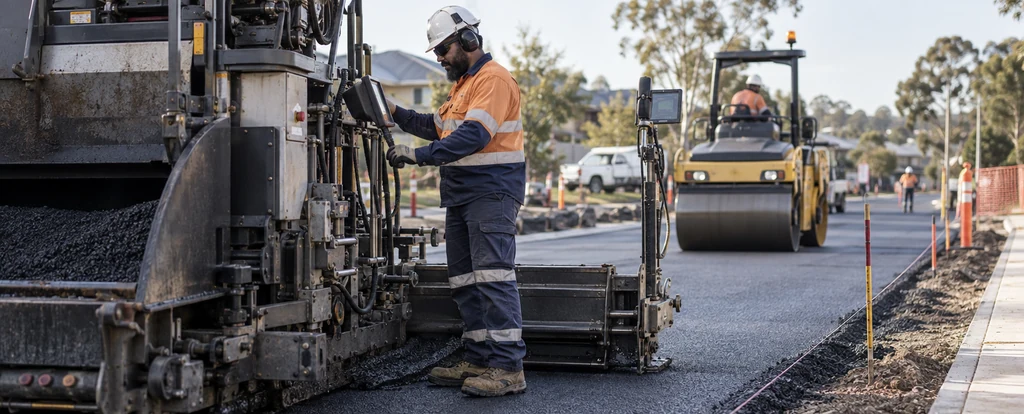
Paving plant operators drive the machines that lay asphalt and concrete on roads, footpaths and car parks, and the surface they leave behind has to be level, durable and safe.
- Median salary*
- $79,000
4.1%vs last year, before tax
- People employed
- 250
25.0%vs last year
- Projected growth
- +3.7%
to 2035
- AI exposure*
- Moderate
- automation risk
- Average hours
- 45/wk
+5h vs all jobs
- Shortage status
- Not in shortage
national
Paving plant operators run self-propelled pavers, screeds and rollers that place asphalt, concrete and precast paving on roads, footpaths, car parks and hardstands. The work sits close to earthmoving, with the difference that the aim is a finished surface held to line and level rather than moving bulk material. Most are employed by civil contractors, and the job is outdoor, shift based and tied to road and infrastructure programs.
How much do paving plant operators earn?
The median full-time salary for a paving plant operator is $79,000 per annum, before tax, up $16,500 since 2018.
What you earn depends heavily on the agreement you are employed under and the shift pattern, since civil construction awards build in loadings for night work, overtime and remote projects. Operators who hold licences for several machines and can move between them tend to sit at the higher end. Large road and rail projects usually pay better than small residential paving work.
What does a paving plant operator do day to day?
The list below is what fills most weeks; the exact mix shifts with seniority and whatever stage the current work is at.
- Operating asphalt and concrete paving machines to lay road, footpath and hardstand surfaces
- Setting screed height, width and crown to match the job specification, then watching the finished surface behind the machine
- Adjusting paver speed and material feed so the mat goes down even and takes compaction properly
- Working with grade controllers and surveyors to hold line and level, and checking levels as the paving train moves
- Carrying out daily pre-start checks and minor maintenance on the paver, screed and rollers, because a breakdown stops the whole crew
What skills do paving plant operators need?
Employers look for plant and equipment operation, worksite safety management, reading plans and specifications, backed by Topcon 3D-MC grade control fluency and strong attention to detail.
Specialist skills
- Plant and equipment operation
- Worksite safety management
- Reading plans and specifications
- Installation and maintenance
- Process improvement
- Hand and power tool work
Software and tools
- Topcon 3D-MC grade control
- Trimble Earthworks machine control
- Leica iCON excavator and paver systems
- Asphalt paver screed controls
- Vibratory roller
General skills
- Attention to detail
- Time and deadline management
Is the job growing?
About 250 people work as paving plant operators in Australia, and employment is projected to grow 3.7% over the decade to 2035. That's modest growth: demand is steady rather than booming.
How do you become a paving plant operator?
Here's the path most paving plant operators take, step by step.
- 1Start on a civil or asphalt crew
Most paving plant operators begin as a labourer or asphalt hand, raking behind the paver, spotting trucks and learning how a paving train works before they get into a machine. It is paid work and no formal qualification is needed to start.
- 2Get your White Card
The general construction induction card is required to work on a construction site in every state and territory, and it is a short course you can complete before you start looking for work.
- 3Complete a Certificate III in Civil Construction (Plant Operations)
This is the standard qualification for machine operation on civil sites, usually done as a traineeship with your employer so you learn on real projects while being assessed. It covers machine operation, setout, compaction and site safety.
- 4Add licences for more machines
Roller, skid steer, excavator and, on some sites, high risk work licences widen what you can be put on. Employers value operators who can move between machines, and the assessment and logbook hours usually run alongside full-time work.
- 5Learn the grade control systems
Training on Topcon 3D-MC or Trimble Earthworks machine control makes you employable on larger projects, where the paver follows a design model rather than string lines. Short courses through the equipment suppliers or your employer cover most of it.
Ready to apply as a paving plant operator?
Whether you're working toward becoming a paving plant operator or already are one and want a hand with the next step (sharpening your resume for ATS screening, tightening your cover letter, or knowing what you'll actually be asked at interview), here are examples grounded in this specific role, not generic templates.
What jobs can a paving plant operator move to?
Moving into Miner typically comes with the biggest pay rise, worth $72,200 a year more on average.
| Move to | Typical pay change | Overlap | Retraining |
|---|---|---|---|
| Miner Paving operators bring heavy plant control and site safety, which mining roles value, though the move needs significant retraining. | +$72,200 | 37% | reskill |
| Earthmoving Plant Operator Paving plant operators bring precise level control and heavy machine handling to earthmoving work, which needs additional tickets for the larger equipment.Known move | +$24,000 | 43% | reskill |
| Truck Driver Truck driving lets paving operators use their roadwork knowledge and heavy vehicle awareness, with a heavy vehicle licence required for the move.Known move | +$22,900 | 7% | reskill |
| Grader Operator Paving operators already read levels and finish surfaces, so grader work builds on those skills with a short course. | +$22,400 | 52% | short course |
| Roller Operator Paving operators understand asphalt laying and compaction, so moving onto rollers is a natural step that needs a roller ticket. | +$17,200 | 40% | reskill |
Moves are chosen from Jobs and Skills Australia's Data on Occupation Mobility, which follows income tax records between 2011-12 and 2020-21, together with entry requirements and skill overlap. A known move is one people were seen making in that data. Pay change compares median full-time pay for the two roles.
Who works as a paving plant operator?
The typical paving plant operator is 39 years old; 100% are men, 88% work full-time, and full-timers average 45 hours a week.
- 39
- Median age
- 0%
- Female share
- 88%
- Full-time
- +5h
- vs all-jobs avg
What's it like being a paving plant operator?
The rhythm of the job follows the paving program: an early start, a run of trucks arriving with mix, and a surface that has to be finished before it cools or sets. It suits someone who likes working outdoors with machinery, is comfortable making small adjustments under time pressure, and does not mind long shifts in the seat. Much of the day is spent watching the surface behind you and reacting, so patience and attention matter as much as machine skill.
What people like
- You can see what you built. A finished stretch of road or footpath stays there for years, and you know which shift laid it. That visible result is a large part of why operators stay in the work.
- Your own machine, your own cab. A lot of the day is spent working independently, with the crew checking in when the mix arrives or the level needs another look. You are responsible for your machine rather than standing in a group.
- Skills that carry across machines and sites. Level control, compaction and site safety transfer to rollers, graders and excavators, so you can change machines or move to a different crew without starting over.
- Learning the technology as it changes. Machine control has moved paving from string lines to design models and screens in the cab, and picking that up keeps the work interesting.
What people find hard
- Weather and night closures. Road resurfacing often happens at night when traffic is off the road, and summer heat or rain can stop a pour partway through a shift. The schedule is set by the project, not by how you feel on the day.
- Long hours in the seat. Full-time work averages around 45 hours a week, much of it sitting in a machine with engine noise and vibration. It is more tiring than it looks from outside.
- Waiting on trucks and mix. Asphalt and concrete arrive on someone else's schedule, so a slow batch plant or a traffic delay leaves you sitting on a machine that is ready to go. You still finish the shift when the surface is done.
- Collecting the licences takes time. Employers want operators who can run more than one machine, so building up competency assessments and licences runs alongside full-time work rather than before it.
Based on our synthesis of professional-body surveys and public accounts of the role, not first-person verified reviews.
Which industries employ paving plant operators?
Construction employs the largest share of paving plant operators, followed by Public Administration and Safety.
Top employing industries
- 1Construction
- 2Public Administration and Safety
Ranked by employment share; the source doesn't publish an exact percentage per industry.
| Year 12 or below | 57.2% | |
|---|---|---|
| Certificate III/IV | 32.4% | |
| Diploma / Advanced Diploma | 3.6% | |
| Bachelor degree | 2% | |
| Postgraduate | 0% |
Will AI replace paving plant operators?
Automation has a moderate reach into this job. Grade control and machine control systems now calculate levels from a design model and hold the screed to them, which has removed most of the string line and constant manual checking from paving work. What they do not do is judge how a particular mix is behaving, finish around kerbs and service covers, or make decisions about safety on a live site, and that is where the operator's time goes.
Share of typical working time by exposure level
- Running the paver and screedMachine control holds grade and slope on most projects, but the operator still reads the mat behind the machine and changes screed height or material feed when it starts to tear or ride.30%moderate
- Grade control and setout work3D systems such as Topcon 3D-MC and Trimble Earthworks take levels straight from the survey model, so the operator is checking the screen rather than setting and reading string lines by hand.25%high
- Compaction and finishingJudging how many roller passes a surface needs, working around manholes and kerbs, and hand finishing edges still come down to eye and feel.25%low
- Pre-start checks, maintenance and site recordsMachine telematics and digital checklists log hours, faults and daily inspections automatically, while the operator still walks the machine and reports what they actually find.20%moderate
Common questions about becoming a paving plant operator
Straight answers to the questions people ask most.
How much do paving plant operators earn?
Full-time paving plant operators earn a median of $79,000 per year before tax. What you actually take home depends on the enterprise agreement or award you work under, shift and night loadings, and how many machines you are licensed to run. Operators on large civil projects with regular overtime and site allowances usually sit above the middle of that range.
How do you become a paving plant operator?
Most people start as a civil construction labourer or asphalt hand and move onto a machine once they understand how a paving crew works. You need a White Card to get on site, and the Certificate III in Civil Construction (Plant Operations) is the qualification employers look for. The transition from labourer to operator usually happens with the same employer, through a traineeship or on-the-job competency assessment.
Are paving plant operators in demand?
Paving plant operators are currently not in shortage, and employment is projected to grow 3.7% over the decade to 2035. The occupation is small, with about 250 people working in it, so openings come mainly from experienced operators moving on and from civil construction programs hiring. Work is concentrated in road, rail and infrastructure projects, which rise and fall with public spending.
Will AI and automation replace paving plant operators?
Machine control has already taken over much of the level holding, with 3D systems reading a design model instead of string lines. What stays with the operator is judging the material, adjusting the screed as conditions change, finishing around kerbs, manholes and services, and working safely around live traffic. The job is shifting towards monitoring and fine adjustment rather than constant manual work.
What can paving plant operators move into?
Earthmoving plant operator uses the same machine control and site safety skills on larger equipment and pays $24,000 more a year, though the move needs additional licences. Grader and roller operator roles build on level and finishing work, with each requiring its own licence or short course. Truck driving is another option for operators who know roadwork and hold a heavy vehicle licence, and it pays $22,900 more a year.
What hours do paving plant operators work?
Full-time paving plant operators average about 45 hours a week, and much of that falls on early starts or night shifts when a road has to be closed to traffic. Civil projects often run overtime during a paving program, and the work is outdoors in all weather. Some operators move to a five-day schedule with a smaller residential contractor once they have the experience.
Related roles
- Earthmoving Plant Operator
- Truck Driver
- Miner
- Roller Operator
- Grader Operator
- Civil Construction Labourer
Not sure this is you? Take the career quiz and get a ranked shortlist of roles that fit how you like to work.